Timeline of Events
| Date | Event |
|---|---|
| March 3, 1991 | Rodney King is beaten by police officers and caught on tape by George Holliday |
| April 29, 1992 | Sgt. Stacey Loon, Officer Laurence Powel, Officer Theodore Briseno, and Officer Timothy Wind are acquitted by a jury unconvinced that the tape shown represents the entire story. Police respond to first reports of trouble at Florence and Normandie. Later, Mayor Tom Bradley calls a state of emergency. |
| April 30, 1992 | Curfew and sales restrictions declared. The National Guard is officially deployed into Los Angeles. |
| May 1, 1992 | Scores of merchants begin arming themselves in Koreatown. Rodney King makes a public statement urging calm. |
| May 4, 1992 | Los Angeles returns to work and school. |
| May 11, 1992 | William H. Webster appointed to investigate LAPD’s response to the riots. |
| April 17, 1993 | Officer Koon and Powell found guilty of violating Rodney King’s civil rights. |
| April 25, 2012 | More than 60 people lose their lives in the riots. Ten were shot to death my law enforcement; Forty-four people died in other homicides or incidents tied to rioting. |
| June 17, 2012 | Rodney King dies at 47 and is found at the bottom of his swimming pool. |
Historical Overview
In March 1991, Rodney King, who was on parole for robbery, led police on a high-speed chase through Los Angeles. Later, he was charged with driving under the influence. When police finally stopped him, King was ordered out of the car. However, instead of arresting him, Los Angeles Police Department officers kicked him repeatedly and beat him with batons for a reported 15 minutes. The video of the incident, which was filmed by a bystander, showed that more than a dozen cops stood by, watching and commenting on the beating. The footage sparked outrage and protests across the country, as it was seen as evidence of systemic police brutality and racism.
King's injuries were severe, resulting in skull fractures, broken bones and teeth, and permanent brain damage. In the aftermath of the incident, a trial was held, and four LAPD officers were charged with assault with a deadly weapon and use of excessive force. Despite being charged with excessive use of force, a jury consisting of 12 residents from Ventura County found the four officers not guilty. The decision enraged the public, who saw it as a clear example of the systemic racial and economic inequality in the city. The reaction was particularly violent in South Central Los Angeles, where over half the population was black. The neighborhood had been grappling with a range of issues including high unemployment rates, a drug epidemic, and high levels of gang activity and violent crime. The riots ignited a national conversation about police use of force and economic and racial disparity that continues to this day.
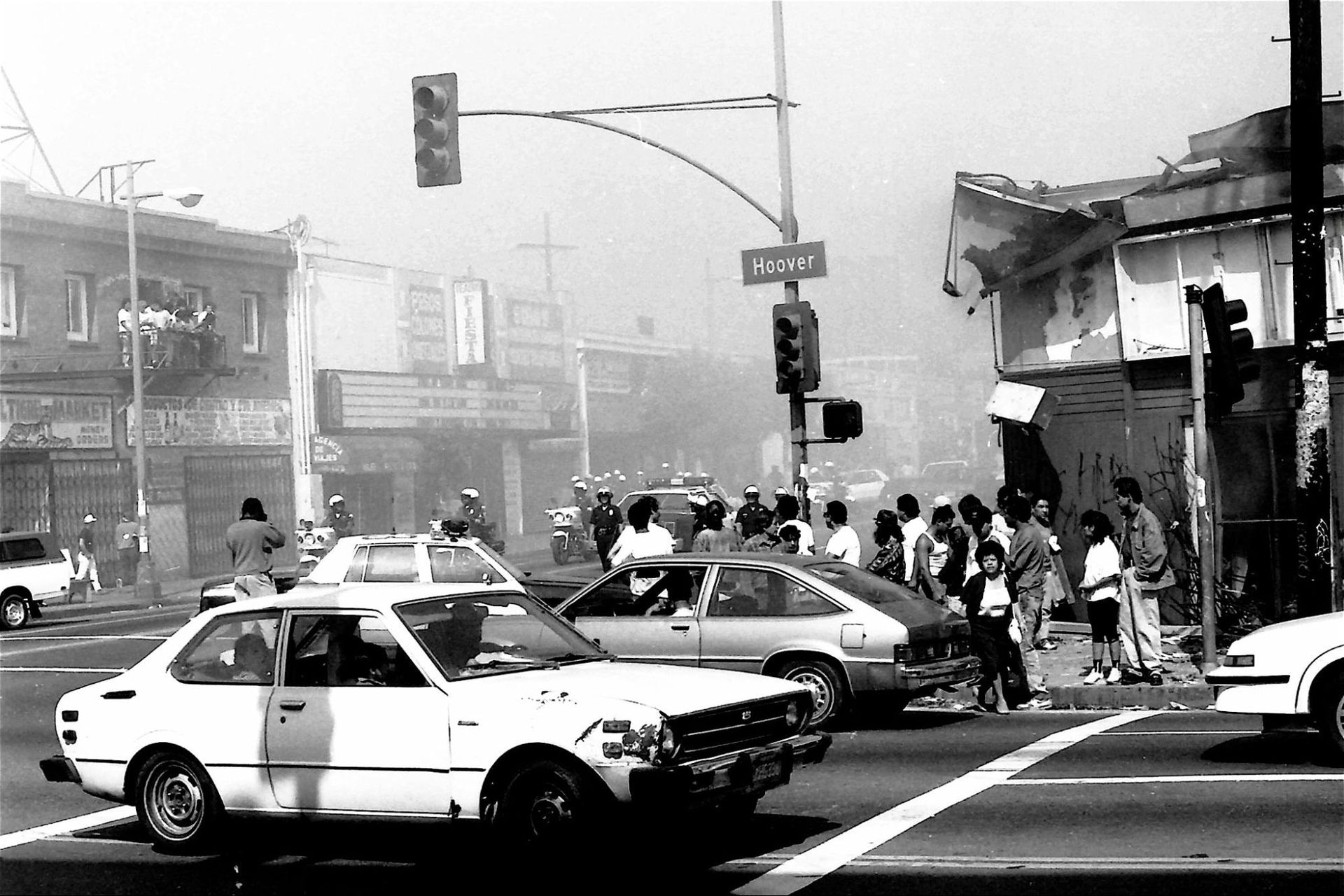
As violence erupted in the Florence and Normandie area, the unrest quickly spread to other parts of the city. Mayor Tom Bradley called a state of emergency and Governor Pete Wilson ordered the National Guard to activate 2,000 reserve soldiers. A curfew was declared, and the sale of ammunition and gasoline was prohibited. The National Guard was deployed, and scores of merchants armed themselves to protect their businesses from looters and firebombs. Rodney G. King broke his silence, urging calm and asking, "Can we all get along?"
The riots lasted for five days, resulting in over 60 deaths, including 10 people who were shot by law enforcement officials. The riots ended on May 4, 1992, and Los Angeles returned to work and school. The LAPD's response to the riots was heavily criticized, and a federal investigation was launched. In April 1993, two officers were found guilty of violating Rodney King's civil rights. The Rodney King riots, as they came to be known, lasted for several days, resulting in widespread looting, arson, and violence. The incident and its aftermath highlighted the deep-seated issues of police brutality, racism, and injustice in the United States. The Rodney King beating became a symbol of the struggle for civil rights and police reform, and it continues to be studied and discussed to this day.
The Los Angeles Police Department & LA Community
The relationship between the Korean and Black communities during and after the LA Riots is complex and multifaceted, with both moments of solidarity and moments of conflict and division. While efforts were made such as Korean American businesses provided shelter and protection to Black residents during the riots and Korean church leaders formed the Black-Korean Alliance to address the underlying causes of the tension between the two communities, tensions were exacerbated as events during the riots unfolded. In specific, an incident involving a Korean store owner shooting and killing an African-American girl named Latasha Harlins further exacerbated these tensions. The incident heightened frustration among the black community with the criminal justice system, which gave the store owner probation and a $500 fine despite clear evidence that Harlins was clutching money to pay for the juice. As a result, many in the Black community felt abandoned by the police when their shops were looted and burned. Meanwhile, Korean shopkeepers complained that government promises of immediate aid had not been honored, and Small Business Administration loans required documentation that most informally operated Korean businesses did not have.
Additionally, LAPD's treatment of the community during this time further fueled the unrest. African-Americans reported being harassed without cause and felt unprotected during times of need, while the LAPD was almost an occupying force, particularly biased against people of color. Furthermore, the LAPD was not adequately prepared for the riots, and there was no official plan for major social unrest on this scale. The result was over 1,000 buildings being damaged or destroyed, with approximately 2,000 Korean-run businesses also being damaged or destroyed, resulting in approximately $1 billion worth of property damage.
The Significance of the 1992 Los Angeles Riots
The Rodney King riots were a watershed moment in American history that revealed deep-seated racial and economic inequalities in Los Angeles and throughout the country. The video evidence of Rodney King's brutal beating by police officers was the first time that many people outside the African-American community had seen visual proof of police brutality that had been reported for years. The acquittal of the officers responsible for King's beating led to an outpouring of frustration, anger, and despair from communities of color who felt that the criminal justice system was stacked against them.
Unfortunately, the issues that sparked the Rodney King riots have not been fully resolved. Videos of police brutality against Black and Brown people continue to surface, and the aftermath of the deaths of George Floyd, Breonna Taylor, and other Black Americans at the hands of police have sparked renewed protests and riots in recent years. The riots in Baltimore, Michigan, and elsewhere have exposed the deep-seated problems of racism, inequality, and police brutality that continue to plague American society.
It is important for people to learn about the Rodney King riots and other protests and riots because they highlight the need for continued vigilance and action against systemic racism and inequality. By understanding the root causes of these events, we can work towards building a more just and equitable society for all people. We must continue to support and amplify the voices of marginalized communities and work towards reforming systems that perpetuate inequality and discrimination.
Support:
There are many ways to get involved and support social justice and activism for the African-American community. Here are some organizations and resources you can support and get involved with:
- Black Lives Matter: This organization has been instrumental in the fight against police brutality and systemic racism against Black people. You can donate to their cause or find ways to get involved on their website.
- NAACP Legal Defense Fund: This organization works to defend the rights of African-Americans through litigation, advocacy, and public education. You can donate or sign up for their email newsletter to stay informed.
- Color of Change: This organization works to create a more equitable society for Black people through campaigns and initiatives that hold those in power accountable. You can sign up for their email list or donate to their cause.
- Campaign Zero: This organization works to end police violence in America through research-based policy solutions. You can donate or find ways to get involved on their website.
- The Bail Project: This organization works to combat mass incarceration by providing bail assistance to those who can't afford it. You can donate to their cause or find ways to get involved on their website.
- Showing Up for Racial Justice (SURJ): A national network of groups and individuals organizing White people for racial justice. You can join a local chapter or donate to support their work.
- Center for Policing Equity: The Center for Policing Equity is a research and action think tank that works to promote fairness and equity in policing. They use data to help communities and police departments develop policies that improve relationships and promote public safety.
- Center for Policing Equity: The Center for Policing Equity is a research and action think tank that works to promote fairness and equity in policing. They use data to help communities and police departments develop policies that improve relationships and promote public safety.
- Center for Policing Equity: The Center for Policing Equity is a research and action think tank that works to promote fairness and equity in policing. They use data to help communities and police departments develop policies that improve relationships and promote public safety.
- Educate yourself and others: Read books, watch documentaries, and listen to podcasts that focus on the experiences of African-Americans and the history of racism in America. Engage in conversations with friends and family to help raise awareness and promote change.
- Advocate for policy change: Contact your elected officials to express your support for policies that promote racial justice, such as police reform, voting rights protections, and economic equity measures.
- Support black-owned businesses: Economic empowerment is an important part of promoting racial justice. Look for opportunities to support black-owned businesses and entrepreneurs in your community.
| Category | Description |
|---|---|
| Books | "Twilight: Los Angeles, 1992" by Anna Deavere Smith <br><br> "The Riot Within: My Journey from Rebellion to Redemption" by Rodney King <br><br> "L.A. '92: The Riots Nobody Expected" by Joseph A. Rodriguez <br><br> "No Justice: The Story of Rodney King" by Ron Scott <br><br> "All Involved" by Ryan Gattis |
| Podcasts | "Gangster Capitalism" by C13Originals (Episodes 1-4 cover the Rodney King Riots) <br><br> "Behind the Police" by iHeartRadio (Episode 6 covers the Rodney King Riots) <br><br> "The Black History Buff" by The Black History Buff (Episode 31 covers the Rodney King Riots) <br><br> "Slow Burn" by Slate (Season 3, Episodes 1-5 cover the Rodney King Riots) |
| Documentaries | "Gangster Capitalism" by C13Originals (Episodes 1-4 cover the Rodney King Riots) <br><br> "Behind the Police" by iHeartRadio (Episode 6 covers the Rodney King Riots) <br><br> "The Black History Buff" by The Black History Buff (Episode 31 covers the Rodney King Riots) <br><br> "Slow Burn" by Slate (Season 3, Episodes 1-5 cover the Rodney King Riots) |
References
-
“About the LA Riots.” LAist, April 29, 2017. https://laist.com/2017/04/29/la_riots.php.
-
Los Angeles Times Staff. “The L.A. Riots: 25 Years Later.” Los Angeles Times, April 26, 2017. https://timelines.latimes.com/los-angeles-riots/.
-
“Koreans Rethink Life in Los Angeles.” The New York Times, June 21, 1992. https://www.nytimes.com/1992/06/21/us/koreans-rethink-life-in-los-angeles.html.
-
Krbechek, Anjuli, and Karen Bates. “When La Erupted in Anger: A Look Back at the Rodney King Riots.” The Los Angeles Riots, 25 Years On. NPR, April 26, 2017. https://www.npr.org/2017/04/26/524744989/when-la-erupted-in-anger-a-look-back-at-the-rodney-king-riots.